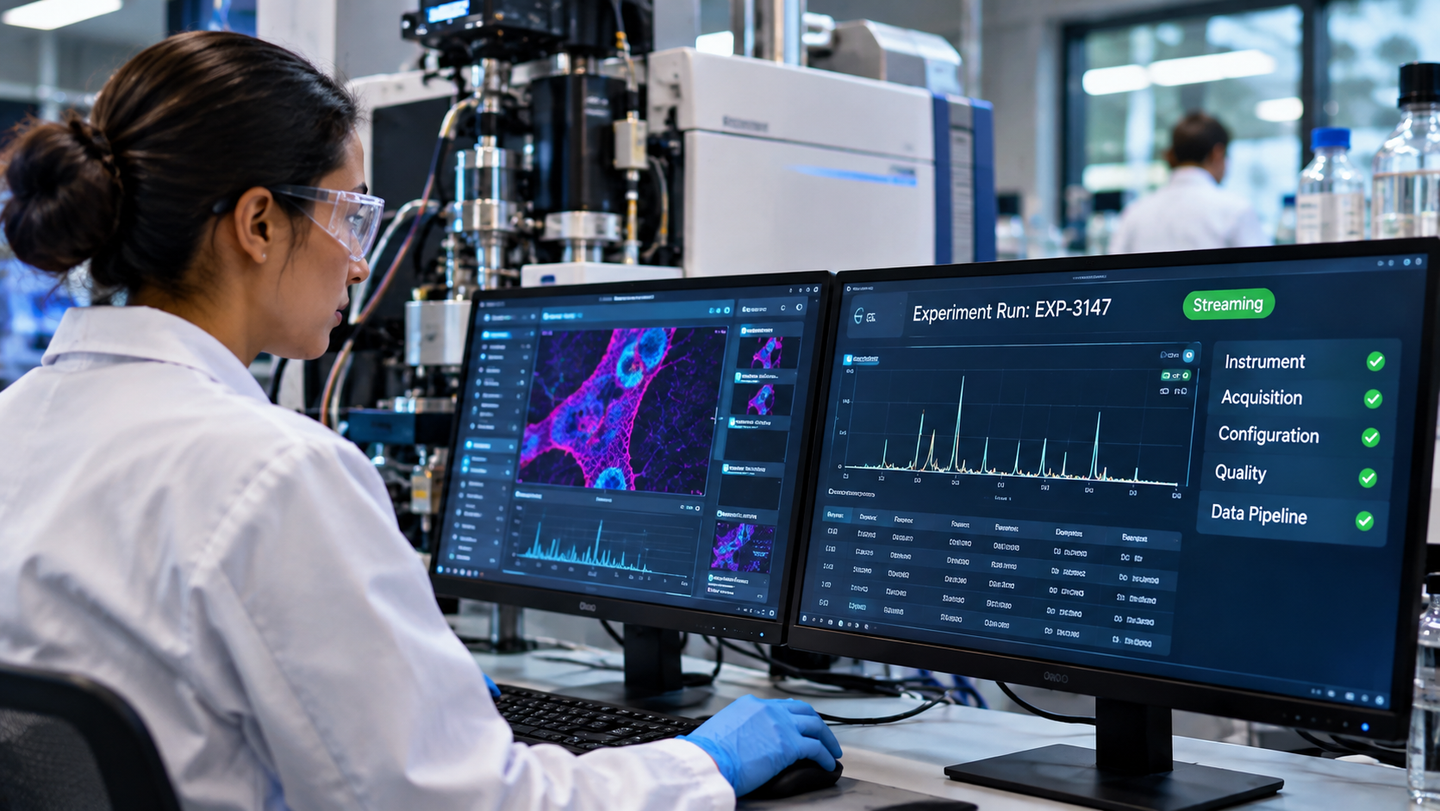
Stream Data From Research Instruments

For a research organization distributing instrument events, Atomic Fusion provides a managed streaming foundation that connects source applications with the services responsible for decisions and follow-through. Where Kafka already carries these events, Atomic replaces that streaming layer while the surrounding applications retain their roles.

The Challenge

  • In this proposed implementation, instrument gateways, experiment-control applications, and laboratory catalogs contribute different parts of the picture. A measurement needs its acquisition context, instrument configuration, and quality indicators to remain scientifically useful; bulk file movement alone does not preserve that meaning.
  • A result loses interpretability when its instrument configuration is missing.
  • Experiment runs can generate concentrated uploads beyond routine lab traffic.
education lab data stream

How it Works

Atomic Fusion provides the Kafka-compatible transport and retained event history between instrument gateways, experiment-control applications, and laboratory catalogs and the downstream processing that turns those events into action. In a representative workflow

  • 1. Capture Changes at Their Source

    Producer applications or an appropriate database change-capture path publish measurement summaries, acquisition markers, configuration versions, file references, and quality flags. Each event includes a stable identifier, source reference, and occurrence time. Use experiment, instrument, and acquisition identifiers to connect an update with related records, and preserve the source reference for later verification. The producer reports the originating business change; it does not assume that publication means every downstream action has completed.

  • 2. Organize and Retain the Even Stream

    Atomic accepts these records into topics organized around experiment, instrument, and acquisition identifiers. Select keys and partitions to support the required entity grouping and consumer processing. Independent consumer groups can use the same published events for the primary workflow and its supporting operational views, without requiring the source to implement a new feed for each consumer.


  • 3. Apply the Workflow Logic

    Downstream, an ingestion service validates metadata and links observations with the relevant experimental configuration. This processing service owns its state, business rules, and any model execution. It writes the resulting view or output to an application database or analytical destination suited to its consumers. Atomic retains the event stream; the destination serves the processed information, and the application updates it as relevant events arrive. It records which source events informed the resulting update, so an operator can connect an application outcome to the evidence available at that time.

  • 4. Deliver the Action and Capture Its Outcome

    Consuming applications queue analysis and make eligible data discoverable to research teams. They publish relevant completion or exception events so the workflow can distinguish a requested action from an acknowledged result. Use suitable repositories for bulk scientific files; preserve calibration and provenance, and keep instrument control separate.

  • The working flow connects instrument gateways, experiment-control applications, and laboratory catalogs to a defined processing step and an observable response, while Atomic supplies the event backbone rather than the business decision.

Why Atomic Fusion

  • Carry Concentrated Measurement Metadata Without Storage-driven Partition Proliferation

    Atomic Fusion delivers 20× higher throughput per partition. A logical partition uses distributed storage rather than concentrating its durable data on one broker. This provides ingestion headroom; consumer processing may still require parallelism.

  • Expand Retained Experiment History Independently of Serving Compute

    Atomic separates Kafka-facing brokers from durable distributed storage. Retained-data capacity can expand independently of request-serving compute, and additional serving brokers do not first need local copies of the partition history.

  • Replay Retained Acquisition Events to Reproduce a Processing Workflow

    All retained events remain on distributed flash storage, without a separate cold tier to retrieve before replay. Consumers can revisit available history for reconstruction or revised processing; retention settings define how far back they can go.

  • Accommodate Bursty Experiment Schedules Without Permanent Peak Capacit

    Atomic Fusion scales up and down elastically with workload, and customers pay for actual use. The service manages underlying capacity, reducing the need to provision the streaming infrastructure around its busiest period.

The Result

Research teams can coordinate analysis from more traceable experiment inputs and reproduce processing with retained acquisition events.

Request a Demo