Durable by Design. Resilient by Construction.
Atomic Fusion is engineered to protect critical streaming data against infrastructure failures. With synchronous replication across availability zones, distributed transactional storage, and automated broker recovery, reliability is foundational, not an afterthought.
Review ArchitectureDurability Before Acknowledgement
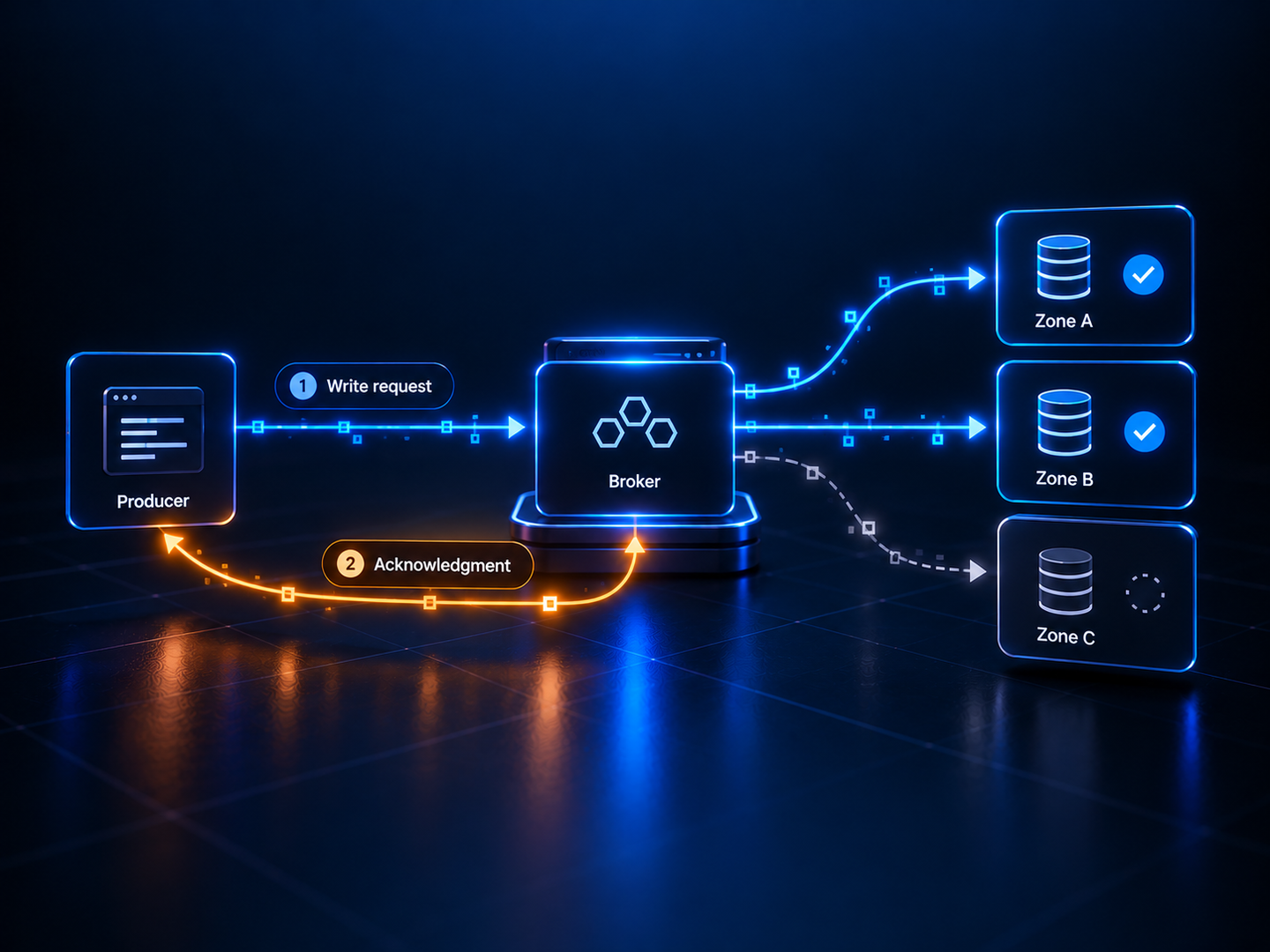
- A successful write should mean your data is actually durable.
- Fusion synchronously replicates stream data across independent availability zones. Before acknowledging a producer write, Fusion ensures that the data has been durably persisted to storage in at least two of three availability zones.
- This durability guarantee is enforced by the underlying storage system, independently of the broker serving the partition.
- Applications can depend on a clear acknowledgement contract without managing replica placement, replication factors, or availability-zone assignments.
Your Data Outlives the Broker
- In traditional Kafka, partition data resides on brokers. When a broker fails, leadership transfers to a surviving in-sync replica, while restoring replication redundancy requires copying partition data to another broker.
- Fusion separates these concerns.
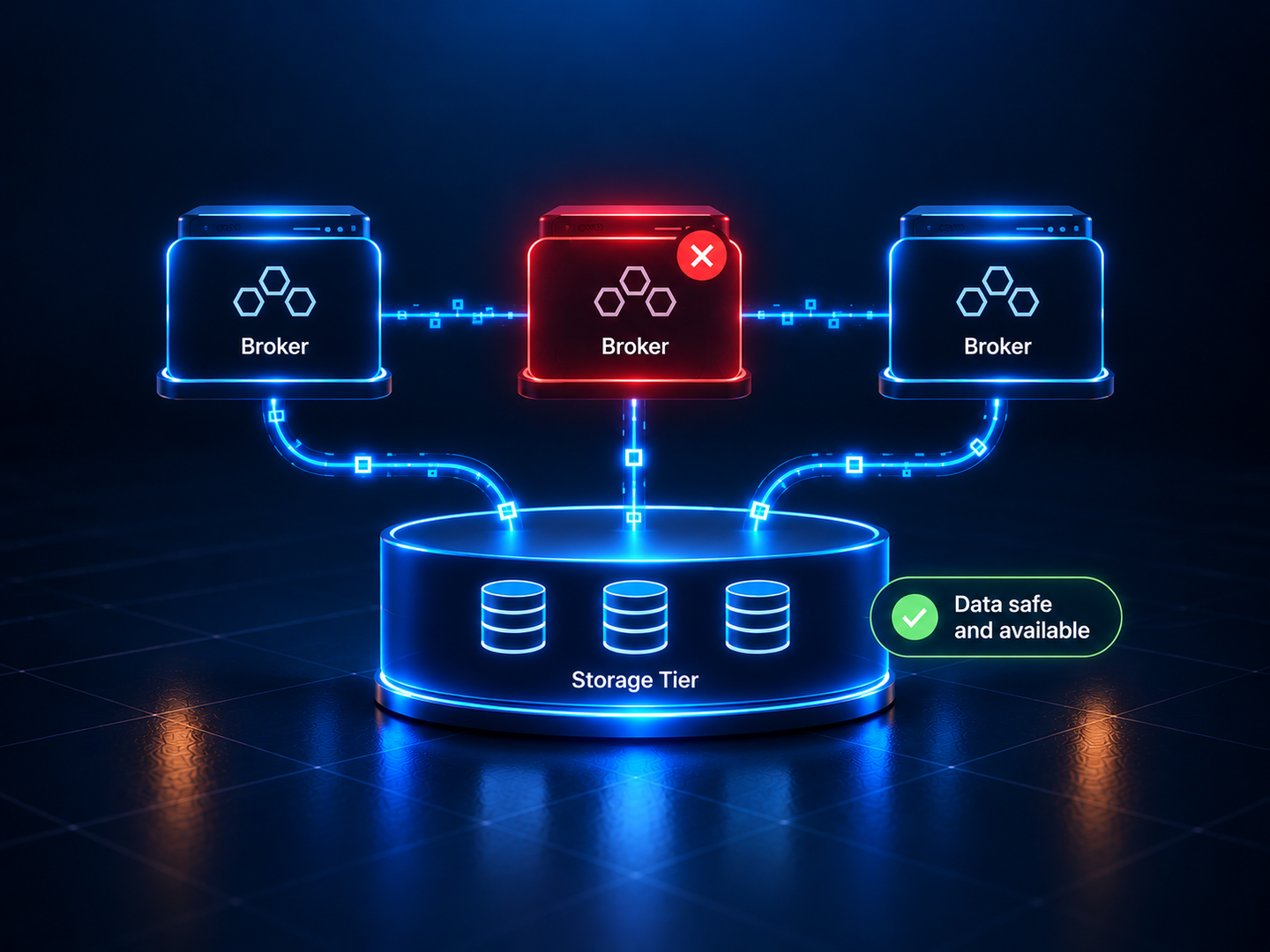
- Brokers handle Kafka protocol operations and coordinate access to partitions, while durable stream data lives in an independent, distributed storage system.
- A failed broker does not take its partition's durable data with it.
- This separation allows Fusion to recover serving capacity without reconstructing partition logs or relocating durable data to replacement brokers.
Automated Recovery When Infrastructure Fails
Hardware failures, process crashes, and network disruptions are unavoidable in distributed systems. Fusion is designed to detect failures and restore service automatically.
Failure Detected
Fusion monitors broker health and automatically detects when a broker becomes unavailable.
Leadership Reassigned
Partitions previously served by the failed broker are reassigned to healthy brokers. Because durable data resides in the independent storage tier, no partition-log relocation is required.
Service Restored
The new lead brokers resume serving the affected partitions. Applications may experience a brief interruption during recovery, but the failure of a broker does not compromise the durability of acknowledged data.
Distributed Storage
Consistency Through Consensus
The result is a streaming architecture designed around both data integrity and operational resilience.
Broker Fleet
Brokers scale independently of storage. Changes in broker capacity and partition leadership do not require relocating durable partition logs.
Paxos-Based Consensus
Coordinates transactional stream operations to maintain consistent state despite component failures.
Quorum-Replicated Storage
Distributes durable stream data across independent storage nodes and availability zones.
Replication, Rethought
Both Apache Kafka and Atomic Fusion replicate data to protect against failures. But their replication protocols take fundamentally different approaches. Kafka uses leader-based, pull-driven log replication. Atomic Fusion uses push-based, synchronous quorum replication backed by distributed transactional storage.
Replication Model
Traditional Kafka
Leader–follower replication.
Atomic Fusion
Leaderless, quorum-based storage replication.
Data Movement
Traditional Kafka
Followers pull new records from the partition leader.
Atomic Fusion
Writes are pushed to distributed storage replicas.
Write Acknowledgement
Traditional Kafka
Configurable; "acks=all" waits for all in-sync replicas.
Atomic Fusion
Acknowledged after durable persistence in at least 2 of 3 availability zones.
Disk Durability
Traditional Kafka
Replication typically relies on the OS page cache rather than requiring a disk flush before acknowledgement.
Atomic Fusion
Writes are flushed to disk before acknowledgement.
Consistency
Traditional Kafka
In-sync replica tracking and leader-based log commitment.
Atomic Fusion
Paxos-based atomic commitment protocol.
Failure Recovery
Traditional Kafka
Leadership transfers to an in-sync replica; restoring redundancy may require copying partition data.
Atomic Fusion
Broker leadership is reassigned without relocating durable partition data.
Build on a Durable Foundation
Mission-critical streaming applications depend on data that remains intact even when the infrastructure serving it is disrupted. Fusion combines synchronous multi-zone durability, independent storage, and automated recovery to provide a resilient foundation for real-time applications.
Request a Demo