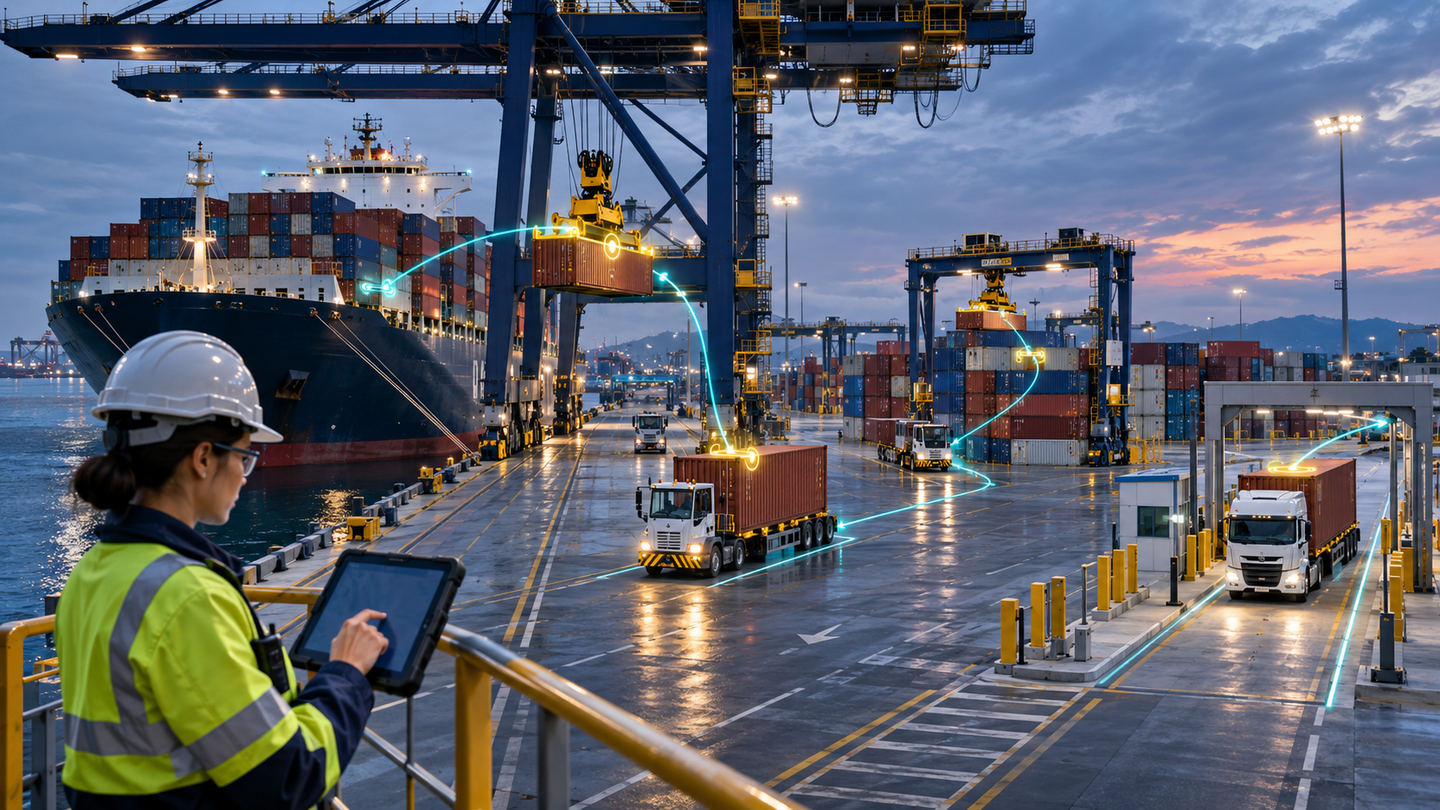
Coordinate Vessel and Container Operations

or a marine terminal or port operator coordinating cargo movement, Atomic Fusion provides a managed streaming foundation that connects vessel-planning applications, terminal systems, equipment gateways, yard operations, and landside logistics. Where Kafka already carries these events, Atomic replaces that streaming layer while the surrounding applications retain their roles.

The Challenge

  • Port operations are a chain of physical handoffs. A container discharged from a vessel may move through a crane assignment, terminal tractor, yard position, release process, and truck pickup before leaving the facility. Changes to a vessel schedule or container status can affect several downstream activities.
  • Simply knowing that an individual task was completed is not enough. Operators need to preserve the relationship between the vessel call, container, equipment movement, and next authorized handoff.
  • A revised vessel arrival or berth assignment can invalidate crane plans and yard staging created against the earlier schedule.
  • A container may be physically available while still waiting for another required milestone before it can move to its next destination.
Port Ops

How it Works

Atomic Fusion provides the Kafka-compatible transport and retained event history connecting vessel scheduling, terminal operations, crane and yard equipment, gate applications, and downstream coordination services. In a representative workflow

  • 1. Capture Vessel and Cargo Events

    Source applications publish vessel arrival updates, berth assignments, discharge and load-plan revisions, crane task completions, container moves, yard-position changes, cargo-release updates, and gate transactions. Each event includes stable vessel-call, container, berth, and task identifiers together with its source reference and occurrence time

  • 2. Preserve the Container Handoff Trail

    Atomic accepts these events into streams organized around vessel calls, containers, and terminal work. The same discharge event can be consumed independently by yard-planning, equipment-management, gate-readiness, and operational-reporting applications without the crane or terminal source system needing to maintain a separate feed for each one.

  • 3. Coordinate Crane-to-Yard Movement

    A downstream terminal coordination application connects the vessel work plan with current equipment and yard conditions. For example, once a quay crane confirms that a container has been discharged, the application can associate that milestone with the assigned terminal tractor and intended yard location. If congestion or a plan revision changes the destination, the coordination service updates its operational state while preserving the original event history.

  • 4. Advance Cargo Through the Next Handoff

    As yard equipment confirms placement, cargo-release systems and gate applications can update the container’s readiness for its next authorized movement. A truck appointment or outbound move is treated as a separate operational milestone rather than assumed complete because the container reached the yard. Exceptions—such as a missing movement confirmation, changed yard slot, or unavailable equipment—can be surfaced to terminal supervisors for action through existing operational systems.

  • The workflow follows the physical genealogy of cargo from vessel to crane, yard, and landside handoff, while Atomic carries the events rather than directing cranes, vehicles, or terminal safety systems.

Why Atomic Fusion

  • Carry Concentrated Vessel and Container Activity Without Storage-driven Partition Proliferation

    Atomic Fusion delivers 20× higher throughput per partition. Because a logical partition uses distributed storage rather than concentrating its durable data on one broker, terminal streams can be organized around operational semantics while still allowing additional partitions where consumer parallelism requires them.

  • Preserve Acknowledged Cargo-movement Milestone

    Atomic acknowledges writes only after durable persistence, including flushing writes to storage across two of three availability zones. This provides a dependable retained foundation for tracing vessel discharge, yard moves, and subsequent cargo handoffs.

  • Replay Retained Terminal Events During an Operational Investigation

    Retained events remain on distributed flash storage without a separate cold tier. Consumers can revisit available vessel and container history to reconstruct a disrupted handoff, investigate dwell time, or rebuild downstream state within the configured retention period.

  • Separate Growing Cargo History From Live Serving Capacity

    Fusion separates Kafka-facing brokers from durable distributed storage. Retained terminal history can grow independently of the compute serving current vessel and equipment events, while Atomic manages the underlying infrastructure.

The Result

Port operators can follow cargo through vessel, crane, yard, and gate milestones with a clearer record of each physical handoff. When vessel plans or terminal conditions change, supervisors can identify which downstream movements are affected without treating every independently completed task as proof that the full cargo workflow is ready.

Request a Damo